



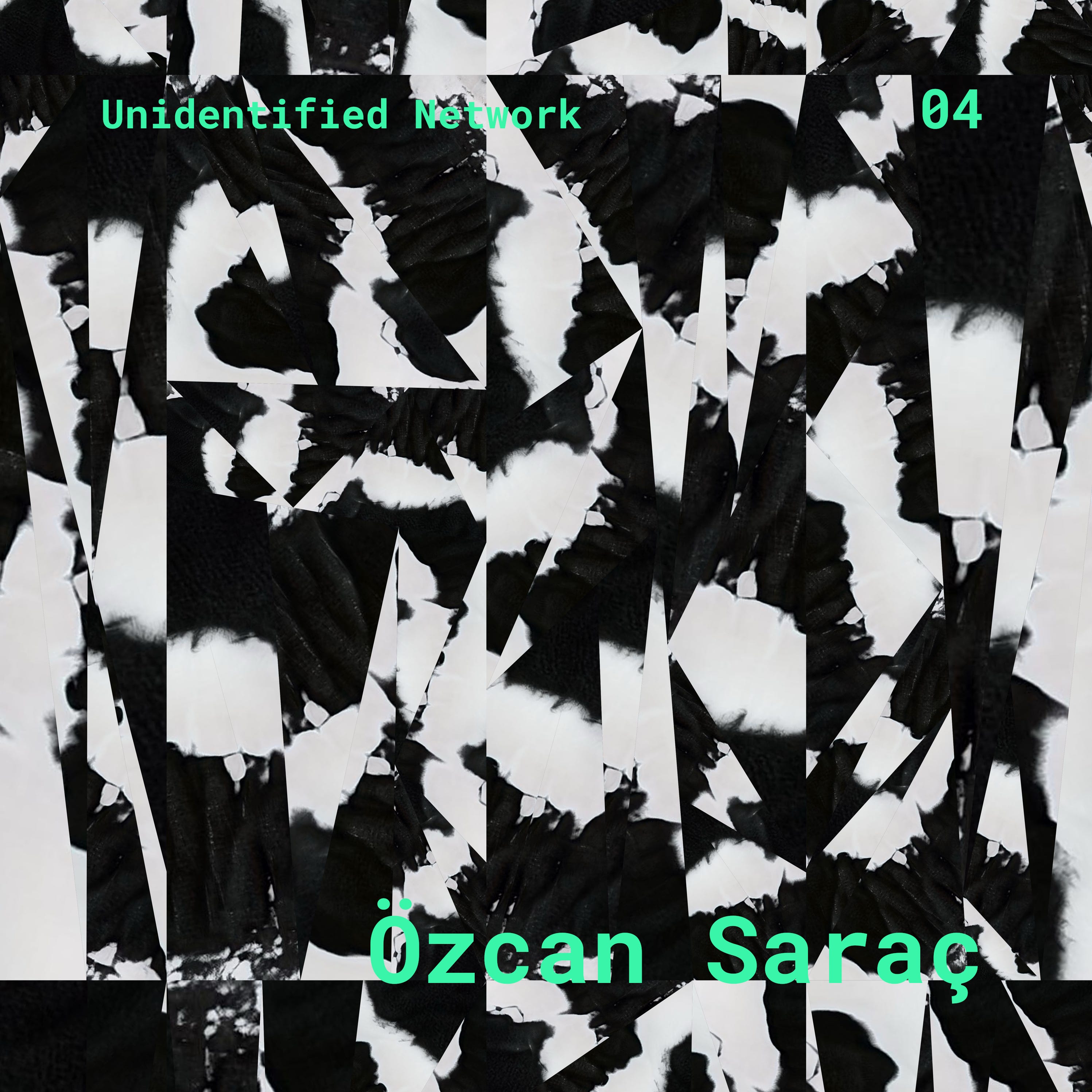
Unidentified Network 04 - Özcan Saraç
Özcan Saraç’s music seems to arrive from a zone in which the future has ceased to behave like the future. It does not advance. It flickers, stalls, corrodes and returns in altered form. Sounds emerge not so much as instruments being played, but as evidence: fragments of a system attempting to remember itself through damaged circuitry.
The music occupies a difficult territory between composition and contamination. Beats appear, but often as compromised structures—rhythms interrupted by static, abrasion and electronic debris. Melodies, when they surface, are less like themes than residual signals. One has the sense of listening to an archive discovered after the institution that created it has disappeared.
There is something distinctly archaeological about this listening experience. The ear moves through layers of digital sediment: glitch, noise, industrial pressure, synthetic atmosphere, fragments of rhythm and microscopic distortions. Yet these sounds do not belong to any stable historical moment. They evoke obsolete futures as much as contemporary technology. A texture can seem simultaneously ancient and impossibly new, like a recording transmitted from a civilisation that mistook computation for memory.
This is particularly striking in the extended forms of releases such as Neural Generators of the Auditory Brainstem Response and OS ZA CR AA NC. Their scale resists the conventional economy of the album. Rather than presenting a sequence of discrete objects, the music creates conditions for immersion. Time becomes viscous. Attention drifts. A sound initially perceived as background gradually becomes the central event; what appeared to be repetition reveals microscopic mutation.
Your work often seems to exist somewhere between composition and sonic environment. When you begin a new piece, do you think of yourself as composing sounds, designing conditions for sounds to emerge, or something else entirely?
I think of composition less as arranging sounds and more as constructing a system in which sound can develop its own behaviour. I establish certain conditions, relationships between frequencies, structures, processes, limitations and then listen to what begins to emerge from them.
I am interested in the point where my decisions stop being completely visible. I don’t necessarily want every event to sound authored. Ideally, the work begins to behave almost like an organism: something initiated by me but capable of producing consequences I could not have entirely anticipated. At that point my role shifts between creator, observer and editor.
There is a strong sense of instability in your music: rhythms fracture, textures deteriorate, and sounds can seem to move between noise and structure. What attracts you to these thresholds, where something is not yet fully recognisable as one thing or another?
That threshold is probably where I feel most comfortable. Once something becomes completely recognisable, we immediately begin categorising it. We understand what it is supposed to be, and therefore we also begin predicting what it will do. I am interested in delaying that moment.
There is a particular tension when something is almost rhythmic, almost harmonic, almost mechanical, almost organic. The listener’s perception keeps attempting to stabilise it, but the object continues changing. For me, that instability creates an active form of listening.
It also reflects how I understand existence more generally. Things rarely remain fixed. Systems form, deteriorate, mutate and reorganise themselves. Noise and structure are not necessarily opposites; one can continuously become the other.
Technology is obviously central to your practice, but your work rarely presents technology as clean, efficient or neutral. What is your relationship with the machine as a creative collaborator? Are you interested in control, unpredictability, failure, or in allowing systems to develop their own logic?
The machine is useful to me precisely because the relationship between control and unpredictability is never completely resolved with the way I interact with it.
I can construct a very precise system, but once enough processes begin interacting, the results can arrive to places beyond my expectations, that is usually when the work becomes interesting.
Technology is therefore not just an instrument for executing an idea. It becomes part of the thinking process itself. I establish rules, the system responds, I react to that response, and gradually a kind of dialogue develops. Authorship becomes distributed between intention, behaviour and perception.
Your recent releases often extend far beyond the conventional length of an album. What does duration allow you to explore that a more concise format cannot? At what point does a collection of tracks become an environment or a space that the listener can inhabit?
Duration changes the relationship between the listener and the work. With shorter forms, there is often an expectation that something should establish itself, develop and resolve relatively quickly. Extended duration allows me to extend that idea.
A sound can exist long enough for its identity to change without necessarily changing very much materially just as forms can stop functioning as forms and begin affecting perception itself. Details that initially seem insignificant can become structural simply because the listener has spent enough time inside them.
At a certain scale, I stop thinking about an album as a sequence of compositions and begin thinking about it architecturally and spiritually. Different pieces become regions within a larger structure. You move through them rather than simply progressing from track one to track two and experience something only you can name so the album becomes less an object that contains music and more a temporal gate.
When working with such extended forms, how do you think about the listener’s attention? Do you imagine someone listening from beginning to end, or are you equally interested in the possibility of drifting in and out—encountering the work almost as one might encounter a landscape?
There is certainly a particular experience available to someone who listens from beginning to end because relationships accumulate over time. Memory becomes part of the composition: something heard an hour earlier can influence how a later event is perceived.
But I also like the idea that the work does not demand continuous attention. A landscape continues existing whether you are examining one detail intensely or allowing your attention to drift. I think sound can function similarly.
You might leave the music psychologically and then suddenly encounter something that pulls you back into it. That movement between attention and absence becomes another layer of the listening experience.
There is often an intense physicality to your sound: pressure, density, repetition and frequency seem to operate directly on the body as much as on the intellect. How conscious are you of the physiological or psychological dimensions of listening when you are composing?
Sound reaches the nervous system before we have fully interpreted what we are hearing. Frequency, pressure, repetition, density and spatial movement can produce very immediate physical responses so that interests me greatly because it places listening somewhere between cognition and embodiment.
I don’t want the work to exist purely as an intellectual proposition. Even when the underlying structures are complex, the experience should remain physical. Ideally those two dimensions become inseparable: the mind encounters the sound while the consciousness continuously attempts to understand what it is encountering.
Do you feel that your practice is concerned with focussing on very specific ideas, or are you more interested in transformation, repetition, decay and the unexpected possibilities that emerge from existing materials and systems?
The specific idea is usually the point of departure rather than the destination.
I often begin with something quite defined, a structure, a process, a scientific concept, a perceptual phenomenon but I’m less interested in illustrating that idea than in discovering what happens when it is subjected to transformation.
Mutation, accumulation and decay are important because they introduce time into the identity of an object. Something does not simply exist, it becomes something.
That distinction is fundamental to my work. I’m interested in processes where identification remains unstable and where the material gradually exceeds the concept that originally produced it.
What are some of the musical, artistic or non-musical influences that have had a lasting effect on the way you think about sound? Are there particular films, books, technologies, environments, scientific ideas or experiences that have shaped your imagination as strongly as music itself?
I’m interested in philosophical exploration, cognition, neuroscience, mathematics, systems theory and the ways complex structures can emerge from relatively simple conditions. Our understanding of being human is particularly fascinating to me, embryological processes, division, differentiation, repetition and the gradual appearance of form from something that initially seems almost abstract.
Many musical and non-musical artists interest me which probably would need another session for it alone but the mix I made for Unidentified Network should give a good sense.
Your work can suggest spaces that feel both futuristic and strangely obsolete at the same time—as if different technological eras are interfering with one another. Do you think sound has its own form of memory? Can a digital sound carry traces of histories, failures or futures that never arrived?
Absolutely. Every technology contains fingerprints about the period that it was produced in. I’m particularly interested in obsolete futures: technologies or aesthetics that once represented something futuristic but now sound unmistakably connected to the past. There is something almost archaeological about that.
A sound can therefore contain several temporal states simultaneously. It can recall a past while still suggesting something that hasn’t happened yet. I like creating situations where those temporal identities become difficult to separate, as though the listener were encountering an artefact whose origin cannot quite be determined.
Looking at your practice as an evolving body of work, what questions are you currently trying to ask through sound? And perhaps more importantly, what remains unresolved—what are you still listening for?
Increasingly, I’m asking where the boundary actually exists between an artwork and a system capable of generating an artwork. if the listener’s perception is constantly reorganising what they hear, where does the composition itself actually reside, in the sound, in the system that generated it, or in consciousness?
My work has gradually become less concerned with producing individual objects and more concerned with constructing a continuum in which each work seems to emerge from, mutate and eventually dissolve into another. I increasingly think of the entire practice as one evolving organism rather than a sequence of separate releases.
What I’m still listening for is the point where a system begins to feel alive where complexity, instability and transformation become sufficient for something to appear to possess its own internal necessity, where I can listen to something I created and momentarily feel that I am encountering it rather than controlling it.
TL:
Özcan Saraç - SA
Boards of Canada - Hydrogen Helium Lithium Leviathan
John Wall - v01 (ds-singularity)
Autechre - pendulu hv moda
Atom™ - Wellen und Felder II
Squarepusher - Drax 2
Lime68k & Nathan Ho - SOLVE
Özcan Saraç - RA
Christina Vantzou - Valley Drone
Luca Bevacqua - Order of the Rose of the Berms
Oneohtrix Point Never - Love In The Time Of Lexapro
Mark Fell - SOA-1
Mika Vainio - Teutons
Ryoji Ikeda - Luxus 1-3
Özcan Saraç - KHU
Artist Links :
https://www.ozcansarac.com
https://www.instagram.com/ozcansarac


